
ZZLL, or the Zbigniew Zborowski Last Layer, is the last step of solving a Rubik’s (3×3) cube using the ZZ-b method (after EOLine, F2L+phasing). It is a reasonably small algorithm set (around 80 unique algs if we ignore PLL) that guarantees 2LLL with OK-ish ergonomics, good recognition and really small move counts (around 24-25, only worse than ZBLL, which is known to be the holy grail of LL methods but has a notoriously large alg count). ZZLL is also a stepping stone of learning full ZBLL. For a detailed statistical analysis of the alg count/move count/number of looks trade-off for various state-of-the-art LS/LL methods developed, please see the following nice plot from mDiPalma (the original post can be found here), where ZZ-b is the approach using full ZZLL. Clealy of all the 2-Look methods, ZZ-b has the lowest move counts (I would count ZBLL as 1-Look method). Funnily I also wanted to learn the [SIMPLE] method in the plot due to its low alg count and move count. However its recognition is really not something for me… Anyways as a COLL/EPLL with occasional WV/CLS user, ZZLL seems to be the most straightforward next step to improve my LL.
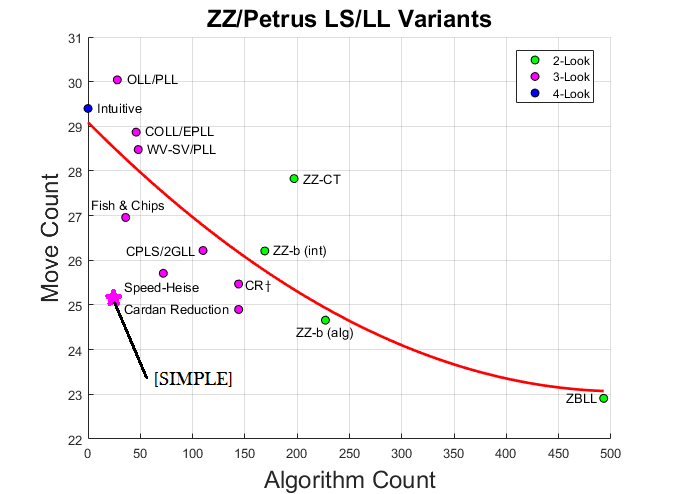
Source: mDiPalma, SpeedSolvingForum
The full ZZLL set has 156 different algs including mirrors and inverses. I have hand-collected and selected these algs from various sources (algdb.net, SpeedSolvingForum, etc.). However I never had the time to really learn the full set of algs, so hopefully this blog will keep me motivated and learn these algs slowly. Nevertheless, I must say that mastering these algs is obviously time consuming and does not necessarily improve your time at all. For me, I learn it just for fun and to get to know more about the cube. It also kinda feels good when you master a large alg set that few cubers will even attempt!
About the algs of ZZLL. ZZLL is the alg set that solves the cube in the state where the first two layers of the cube is solved, all edges are correctly oriented, and opposite edges of the top layer are placed opposite to each other (but not necessarily correctly permuted). The state that ‘opposite edges of the top layer are placed opposite to each other’ is achieved by a simple step called Phasing, which is explained here. The alg set can be most naturally incorporated into ZZ or Petrus solves as both methods orient all edges before LL. For CFOP users, it could be difficult to use this alg set because both orienting edges and phasing are not straightforward at all. I proposed a method for the CFOP users to incorporate ZZLL algs into their solves some time ago, which is posted in this thread. However, I am not convinced that this is beneficial for CFOP users at all. Apparently CFOP just dominates ZZ in competitions so learning ZZLL is probably not going to help CFOP users in any obvious way…
As a pre-requisite of learning ZZLL, you should be familiar with recognition and execution of all COLL algs (including the sune and anti-sune cases which are rarely used). There are two reasons for this: (1) each COLL case is further divided into 4 ZZLL cases based on edge permutations. So if you can recognize COLL, you will at least know which one of the four ZZLL algs you need to perform. (2) Some of the ZZLL cases are just normal COLL cases, so you already know quite a few of them if you know all COLL algs! Also, learning two-side recognition of PLL is recommended, because I find that there are lots of common patterns of PLL algs to ZZLL algs. You might even find that some parts of a ZZLL alg is actually a PLL alg, so knowing full PLL will give you some advantage in learning ZZLL algs.
Finally, about the contents of my posts about ZZLL. I will go through each and every ZZLL case, including recognition, finger trick, inverse and mirror and my own quirks to memorize them. For training ZZLL, you can use Tao Yu’s trainer: Train Yu. Hopefully this will be helpful to all of you who want to learn full ZZLL, and feel free to leave comment if you have suggestions or corrections for any algs that I posted!
Happy cubing!
FredTheCuber
 ZZLL Algs